How to Avoid TV Glare on a Media Wall
Check the proposed TV position from your normal seats in daylight and with the evening lights on before you approve a media wall. If a window or lamp obscures the picture, resolve the light source or layout first. A permanent recess is a poor place to discover that comfortable viewing depends on a blind you do not want to close.
A media wall opposite a window is not automatically ruled out. The decision is whether the room works for your viewing habits with light control you are genuinely happy to use—not whether it looks good in an evening design image.
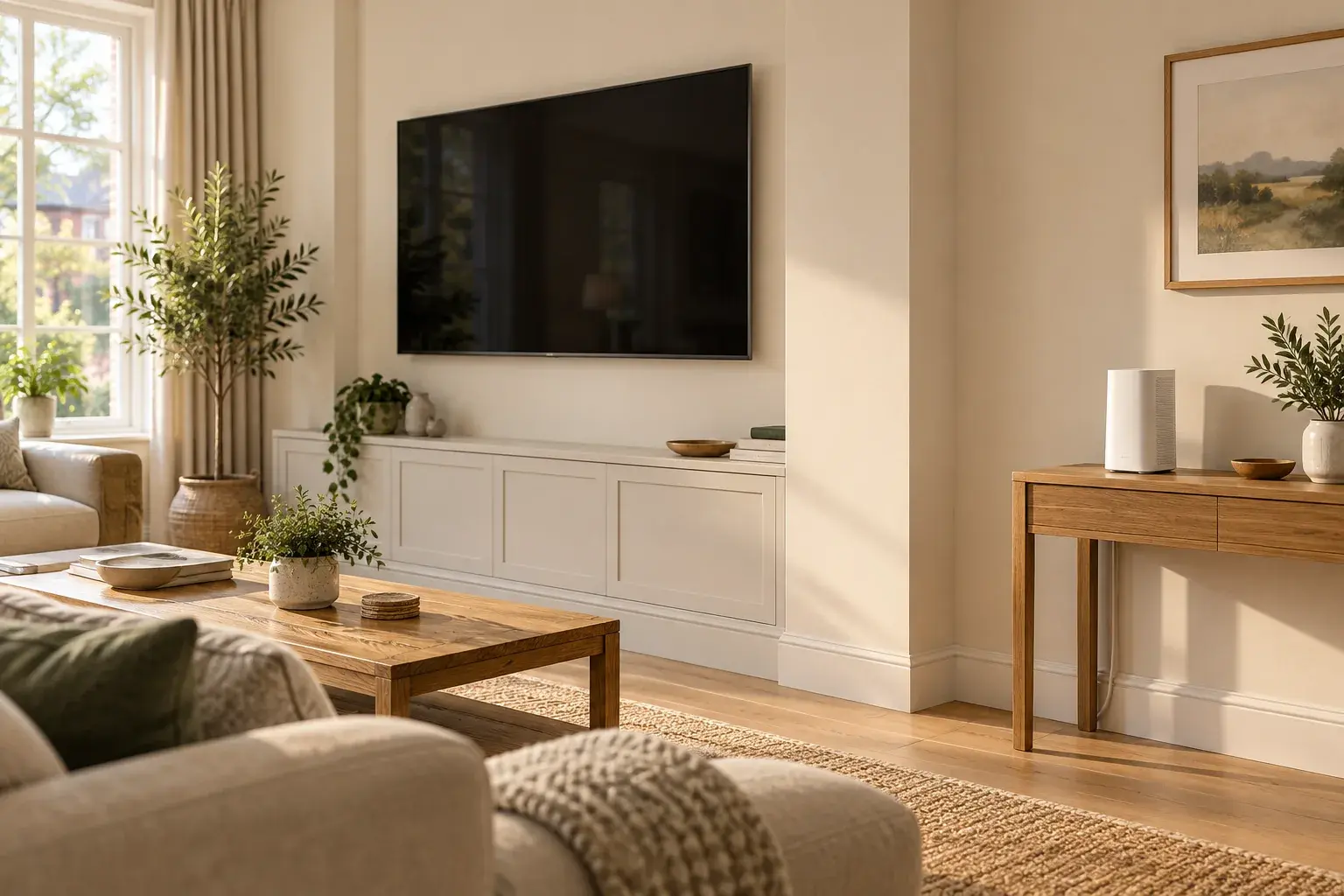
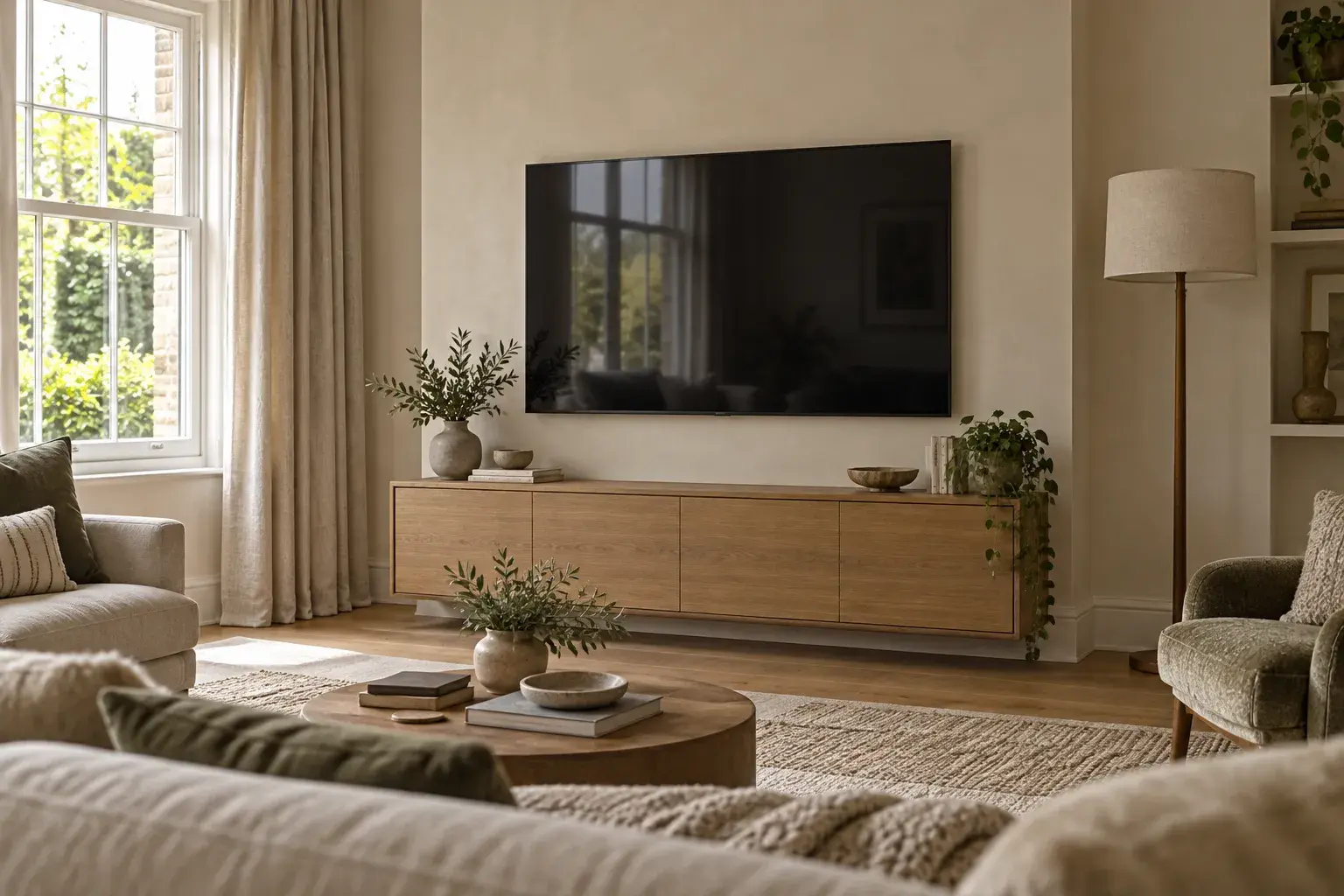
The feature image is an AI-generated editorial concept showing a reflection problem. It is not a customer installation or a tested room layout.
Set the viewing brief before choosing the feature wall
Write down when you watch and which seats matter. Weekend afternoon sport, children's daytime programmes and films after dark can produce different requirements in the same room.
Also decide whether keeping the curtains open is essential, a preference or unimportant. That answer can change the best wall to build on. Do not agree to “we can always shut the blinds” unless that is an acceptable everyday compromise.
Philips' TV placement guidance recommends avoiding direct sunlight and strong reflections, using curtains or blinds where needed, or choosing a wall without direct sun. It also puts the screen in relation to the main seating area. Treat those as things to assess together rather than moving the TV somewhere awkward just to escape one reflection.
Keep the comfortable screen height you have established using our media wall TV height guide. This check is about light, not another calculation of mounting height.
Make a short record of the room as you actually use it
If your existing television is already near the intended position, use it to investigate. TCL's reflection guidance suggests looking at the switched-off screen from your viewing position, then checking a dark scene. It distinguishes recognisable reflections from the more general washed-out appearance caused by bright room lighting.
Use those observations to complete this simple record:
| Viewing situation | What to record | What to try |
|---|---|---|
| Usual daytime viewing | Seat, time, weather and any visible window reflection | Change the existing curtain or blind position and note whether the result is acceptable |
| Brightest conditions you regularly encounter | Which part of the picture is affected, and from which seats | Compare your preferred light-control setting with the room fully shaded |
| Evening viewing | Which lamps or ceiling lights appear on the screen | Switch individual lights off in turn to identify the source |
Use a familiar dark programme scene, not only a bright sports broadcast or shop demonstration. Take a photo as a reminder, but judge with your own eyes: the purpose is to record what interrupts viewing, not produce a camera-based performance measurement.
Repeat the check from the second sofa or favourite armchair. A change that helps one person may leave another looking at a reflection. Note cloudy conditions too, so a successful test on an overcast morning is not mistaken for a test in bright sunshine.
If the TV will move to a different wall, these observations are only a starting point. A taped rectangle shows size and position but cannot reproduce the screen's reflections. Arrange a safe trial with the television on a suitable stand, or discuss a demonstration with the installer; do not balance a screen on improvised supports. An existing TV also cannot prove how a different model will behave.
Use the results to decide: proceed, change or pause
Proceed with the proposed wall when the important seats work in the conditions you have tested and the lighting or blind settings are acceptable. Keep the test notes with the design brief.
Change the room lighting or window treatment when you can identify a manageable source. TCL recommends addressing reflected lamps and daylight rather than relying only on a brighter picture. Test the proposed change before treating it as the solution; a fabric sample or catalogue description does not establish how the finished blind will perform in your room.
Pause the fixed layout when the only satisfactory result requires a compromise you will not use. Ask for an alternative wall or seating arrangement before shelving, sockets and finishes are designed around the original choice. A side-wall position is worth comparing, but it is not a guarantee: assess that position from the seats too.
For example, imagine a household that wants a centred media wall opposite patio doors and watches television through weekend afternoons. Closing the curtains solves their viewing problem, but they want the garden view throughout the day. This is an illustrative decision, not a customer project. Their next step is to compare another TV position—not approve the first wall on the assumption that they will tolerate closed curtains later.
Do not make a new screen or tilt bracket the untested fix
Screen finishes can help. Samsung's bright-room guide explains that its anti-reflection treatments soften reflected shapes, while its matte anti-glare treatments diffuse incoming light. That does not establish the outcome for every television or room.
If replacing the TV, ask to see the shortlisted model under relevant lighting with dark content, then check its actual dimensions before the wall is specified. Our media wall TV size guide covers that separate fit decision.
Similarly, do not assume a small tilt will solve the problem for every seat. If an adjustable mount is part of the proposal, ask the installer to demonstrate the useful viewing positions and confirm compatibility, movement space and access. A tightly framed recess and a screen that needs to move must be designed together.
Include a viewing setting for decorative lighting
Shelf lights can look attractive when the TV is off, but the viewing test should include them too. Ask which lights can be switched separately and, where suitable, dimmed. Keep the option to turn decorative lighting off without losing the lighting you need elsewhere in the room.
Before signing off, send the designer your preferred TV wall, regular seats, viewing times and three or four observation photos. State any non-negotiable preference, such as keeping the garden-facing curtains open, and identify what still needs testing.
Smart Space Living offers bespoke media wall installation across its South Wales service areas. Request a design consultation and quote with those notes, so the proposed wall, TV position and lighting can be considered around everyday viewing—not only the finished appearance.